The History of Chamonix
From Alpine Village to Adventure Capital
From 11th-century monks to the first Winter Olympics — the story of how a remote mountain valley became the world's most celebrated alpine destination.
Shop Chamonix Prints →Tucked beneath the towering Mont Blanc, Chamonix is a town with a story as captivating as its landscape. Known today as the ultimate playground for adventurers, Chamonix's journey from a quiet, remote village to a world-renowned hub for thrill-seekers and nature lovers is filled with tales of exploration, courage, and creativity. Knowing the history of this extraordinary valley makes any visit to it more meaningful.
"Chamonix's story is one of transformation, resilience, and boundless inspiration — a valley that has always drawn those who seek beauty, challenge, and discovery."
First Settlement
Monks and shepherds settle the valley — known as "Chamouny" — as an isolated pastoral community.
The British Explorers Arrive
William Windham and Richard Pococke publish accounts of the valley's glaciers, drawing artists, writers, and scientists from across Europe.
First Ascent of Mont Blanc
Jacques Balmat and Dr. Michel-Gabriel Paccard reach the summit — the birth of modern alpinism.
Mont Blanc Tramway Opens
Infrastructure arrives — the first tramway transports visitors to higher altitudes as Chamonix transitions from remote village to fashionable alpine destination.
First Winter Olympics
Chamonix hosts the inaugural Winter Olympics — cementing its global reputation as a premier winter sports destination.
Aiguille du Midi Cable Car Completed
The cable car to 3,842m opens — making high-altitude adventure accessible and transforming Chamonix for a new generation of visitors.
Humble Beginnings — An Alpine Village
Chamonix's history stretches back to the 11th century when it was a modest alpine village named "Chamouny," settled by monks and shepherds. Life in the valley was simple, revolving around farming, livestock, and a pastoral way of life connected to the rhythms of the mountain year.
Isolated by the rugged terrain that surrounded it, Chamonix remained largely unknown to the outside world. The towering peaks were seen more as barriers than as opportunities, and few outsiders made the journey to this remote region. It was a hidden gem long before that term became fashionable — a place that kept its own quiet counsel for centuries.
The First Explorers Arrive — 1741
In 1741, everything changed with the arrival of two British explorers, William Windham and Richard Pococke. Fascinated by the dramatic glaciers of the Chamonix Valley, they published accounts of their journey — particularly of what they called "Les Glacières de Chamonix" — captivating Europe with tales of this mystical place.
Their descriptions attracted artists, writers, and scientists. For many, the valley brought the pages of Romanticism to life, with landscapes that seemed almost otherworldly. The Mer de Glace glacier, in particular, became a must-see for early visitors. These accounts marked the beginning of Chamonix's transformation from a remote settlement into a destination defined by its natural wonder and air of mystery.

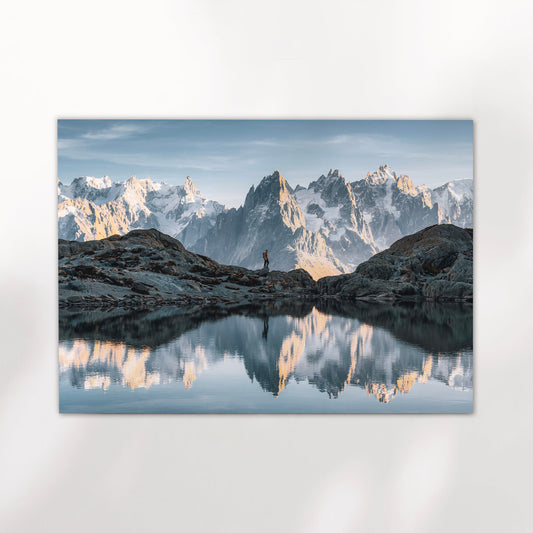
Mont Blanc Massif — The View That Started It All
This is the view that first drew explorers, artists, and climbers to Chamonix in the 18th century — and still stops people in their tracks today. The massif has looked like this for centuries. The light changes; the mountain endures.
View Print →The First Ascent of Mont Blanc — 1786
In 1786, Chamonix cemented its place in mountaineering history. Local guide Jacques Balmat and Dr. Michel-Gabriel Paccard reached the summit of Mont Blanc — a groundbreaking achievement that marked the birth of modern alpinism. Their ascent was not just a personal triumph; it was a moment that changed how Europeans thought about mountains.
News of the climb spread across the continent, inspiring others to take on the challenge of Mont Blanc. The peak became a symbol of ambition and adventure — proof that the highest places on earth were within human reach. This moment firmly established Chamonix as the world's centre of mountaineering, drawing climbers from every corner of Europe and laying the foundation for everything that would follow.

Summiting Mont Blanc
The same route that Balmat and Paccard took in 1786 — now climbed by thousands each year, but still as demanding, as beautiful, and as meaningful as it has always been.
View Print →The Rise of Tourism — 19th Century
The 19th century brought a new wave of visitors as alpine tourism swept across Europe. Wealthy travellers, inspired by stunning artworks and accounts of mountain expeditions, flocked to the valley. Artists and photographers were drawn to the dramatic scenery, capturing Chamonix's beauty for audiences far and wide — many of whom would never make the journey themselves.
Infrastructure developed rapidly to meet these new demands. Inns and hotels were built along the valley floor, and by 1907 the Mont Blanc Tramway began transporting visitors to higher altitudes for the first time. Chamonix's appeal grew steadily as it completed its transition from a remote pastoral community to a fashionable destination for anyone drawn to nature, adventure, and the sublime.
Chamonix on the World Stage — 20th Century
Chamonix entered the global spotlight in 1924 when it hosted the first Winter Olympics. The event transformed the valley into a premier winter sports destination almost overnight. Skiing became a defining attraction, and the completion of the Aiguille du Midi cable car in 1955 — rising to 3,842 metres in two stages — made high-altitude adventure more accessible than ever before.
By the 1960s and 1970s, Chamonix had become a haven for extreme sports of every kind. Ski mountaineering, paragliding, ice climbing, and later freeride skiing all found a home here. Athletes from across the world came to push the limits of what was possible in the mountains. The town consolidated its status as the adventure capital of the Alps — a reputation it has never relinquished.

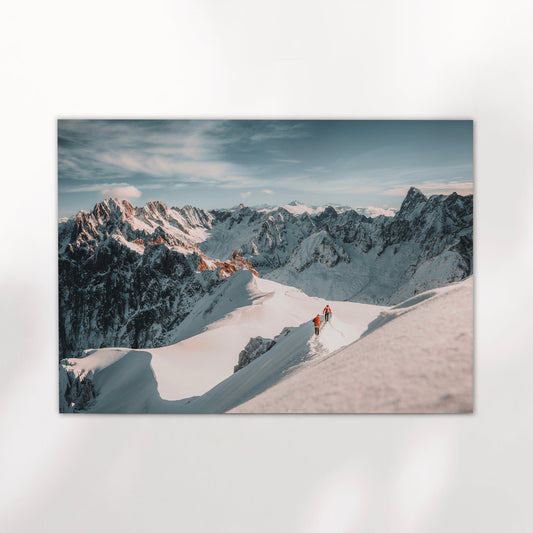
Skiers on the Vallée Blanche
The 20km glacial descent that has defined Chamonix skiing since the Aiguille du Midi cable car opened in 1955. Still, after all these years, one of the great ski experiences in the world.
View Print →Chamonix Today — A Modern Adventure Hub
Today, Chamonix seamlessly blends its rich history with a thoroughly modern adventure culture. Mont Blanc remains a bucket-list climb, the Vallée Blanche draws thousands of skiers each winter, and events like the Ultra-Trail du Mont-Blanc (UTMB) showcase the valley's ongoing position at the forefront of endurance and mountain sports.
The town's commitment to preserving its natural beauty ensures that visitors can continue to marvel at these landscapes for generations to come. Sustainable tourism initiatives and careful environmental stewardship allow Chamonix to remain as pristine and awe-inspiring as it was when the first explorers stumbled upon it in 1741. The mountains have changed — the glaciers have retreated, the infrastructure has grown — but the essential character of the place endures.
"As you hike its trails or gaze up at Mont Blanc, know that you're part of a legacy that has inspired explorers, artists, and adventurers for centuries."

Sunset Over the Mer de Glace
The glacier that first brought explorers to Chamonix in 1741, seen from above at the end of the day. A place with centuries of history behind it — and a reminder of why this valley has always inspired people to look up.
View Print →Bring Chamonix History Home
Fine art prints of the valley that has inspired explorers and adventurers for centuries — from €22,75. Ships worldwide in 3–9 days.
Shop Chamonix Prints → @chamonixprints →