Bavarian Alps Wall Art: Photography Prints from Germany's Most Dramatic Landscapes
Specific, grounded and quietly unlike anywhere else in the Alps.
Shop Now →The Bavarian Alps don't try to intimidate you. That's what makes them interesting, and it's what separates good Bavarian alps wall art from the kind of alpine shot that could have been taken anywhere between Innsbruck and Interlaken. The mountains here are dramatic, but they sit alongside things. Valley towns. Timber farmhouses. Lakes that go perfectly still on autumn mornings. The scale feels human, even when the ridgelines don't.
That combination is harder to photograph well than it sounds. The obvious approach is to go wide and get everything in, but that rarely works. The shots that hold up on a wall tend to be more selective. A single peak against a soft sky. A lake with a boathouse and bare winter trees. A stag in early morning mist with the forest just visible behind him. The detail that makes the place feel like Bavaria specifically, not a generic alpine backdrop.
Most shots of this region are taken from the same handful of viewpoints around Garmisch or above Berchtesgaden, usually at golden hour, usually with a polariser cranked up. The character of the place is quieter than that. You find it in November, or before the valley wakes up. The Zugspitze gets all the attention. The Wetterstein range around it is better to photograph.

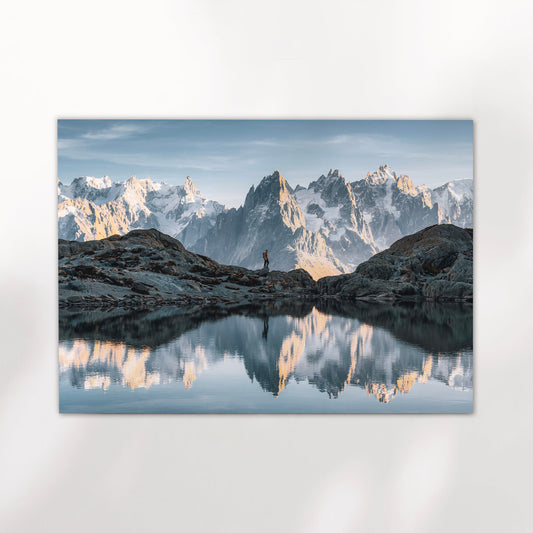
Alpspitze, Bavaria, Germany
The Alpspitze is one of the most recognised peaks in the Wetterstein range, but it's rarely photographed at this hour. The pastel light that sits on the snow-capped faces just before dark is specific to this valley, and this elevation. The cool tones and open sky mean it doesn't fight with much. Works well in rooms that already have white or grey walls. Less so if you're working with warm timber or earthy tones.
View Print →
What Makes Bavarian Alps Photography Different
The thing that separates Bavaria from the Swiss or Italian Alps isn't the height of the peaks. The Zugspitze, at just under 3000 metres, wouldn't make the top fifty in Switzerland. What's different is the relationship between the mountains and the landscape beneath them. The valleys are wide and agricultural. Churches with onion domes appear in the middle distance. The treeline comes lower and the meadows stay longer. It gives the whole region a different texture when you photograph it.
There's also a meteorological detail that makes this part of the Alps genuinely unusual to work in. The Zugspitze plateau sits above a thermal inversion layer on many autumn mornings. The valleys fill with cloud while the summit breaks into sharp, cold light above it. From up there, you're looking at a sea of white stretching into Austria, with German farmland somewhere beneath it and nothing else visible. It's one of the few situations in the Alps where a photograph can have that much space in it without being taken from a plane.
"The valleys fill with cloud. The summit breaks into cold light above it. From up there you're looking at a sea of white stretching into Austria."
That quality of light and space is what makes this landscape worth putting on a wall. The full Bavarian Alps collection covers several distinct parts of the region, each with its own character. The Berchtesgaden area in the south-east feels enclosed and dramatic. The foothills around the Ammersee are quieter, more pastoral. The Wetterstein range near Garmisch has the kind of clean alpine geometry that photographs well in almost any light. These aren't interchangeable. If you know the region, you'll know which one belongs on your wall.


Choosing Bavarian Alps Wall Art for Your Home
The practical question is usually which type of print suits the room. Mountain prints with a lot of sky and open space work well in living rooms, where a large format, something around 70x100cm, gives the image room to breathe. The Alpspitze and Berchtesgaden prints both have that quality. They're not busy. The eye settles somewhere and stays.
The wildlife prints are a different case. The Bavaria Deer print and the Deer Wildlife print from the Bavarian forest both have that misty, close-toned quality that tends to work better in bedrooms, studies or hallways than in big open living rooms. They're quieter images. More intimate. In a room where you spend time on your own, that's not a weakness. For anyone building a wall around a nature theme, the stag prints pair naturally with the Ammersee shot, which has a similar stillness to it. Both are from the same season and the same soft corner of the region, and they hold together well as a pair without being matchy. The same principle applies to mixing prints from neighbouring alpine regions, if you're thinking about a gallery wall that covers more ground.

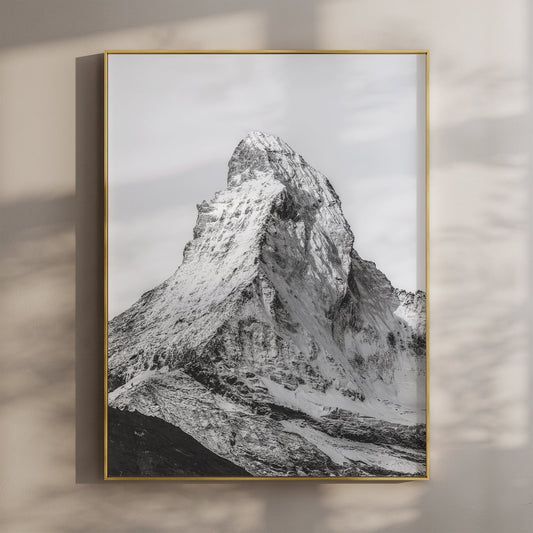
Berchtesgaden, Bavaria, Germany
The Watzmann is one of the most dramatic mountain faces in Germany, and from the valley at Berchtesgaden you can see exactly why it holds that reputation. The church spire in the foreground is what anchors the image. Without it, it's just a mountain print. With it, it's specifically Bavaria. A print for anyone who's stood in that valley and looked up.
View Print →


Bavaria is one of those places that people underestimate as a photography destination. It doesn't have the immediate drama of Zermatt or the showreel quality of the Dolomites. What it has is character. A specific look that you won't confuse with anywhere else once you've spent time there. That's exactly what you want from a print. Browse the full collection if you're looking for something from the wider Alps and beyond.
Mark, Chamonix Prints
Bring Bavaria Home
Every print is made to order on museum-quality paper and shipped to your door. From the Wetterstein to the Ammersee, these are the shots that make the place feel real.
Browse Prints →