How Much Space Between Triptych Panels: A Practical Guide
The gap between panels is the last thing to worry about. Start with the wall around them.
Shop Triptychs →Most people start by measuring how much space between triptych panels to leave, and that's the wrong place to start. The gap between frames is almost invisible once it's on the wall. What you'll actually notice is how much wall is left over on either side, and whether that amount looks deliberate or accidental. Get the outer margins right first. The inter-panel spacing follows naturally.
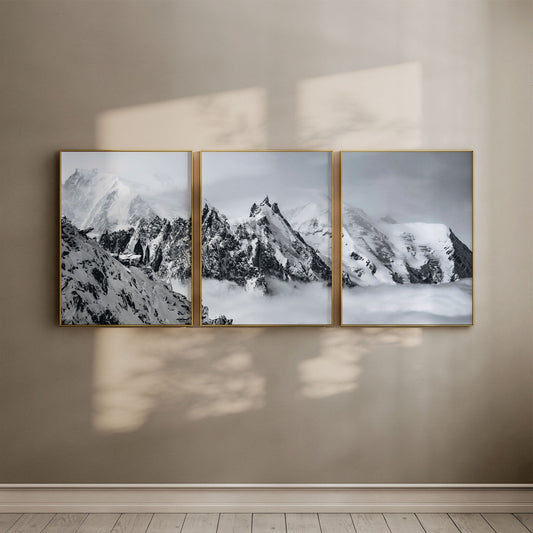
This covers working out whether your wall fits the triptych, where to position it, and what gap to leave between panels. It applies to any triptych format, but the examples here use the Mont Blanc Massif triptych and others from the Chamonix Alps collection, where the image flows continuously across all three panels and spacing decisions are particularly visible.
Start with the wall, not the gap
A triptych hung in the dead centre of a wall with nothing around it looks small and lost, regardless of its actual size. The same triptych with equal margins on left and right reads as a complete, considered artwork. The margins are doing more visual work than the frames are.
The rule that works: aim for the triptych to occupy roughly two thirds of your wall width. The remaining third splits equally either side. On a wall that's 200cm wide, that means the combined width of all three panels plus gaps should be around 130cm, leaving about 35cm on each side. The ratio matters more than hitting exact numbers. Go wider than two thirds and the triptych starts to crowd the wall. Go narrower and it starts to float.
This matters more than almost anything else because it's the first thing the eye reads. Before anyone registers the subject of the photograph, they register whether the hung object looks like it belongs on that wall. Margins are how you control that. If you're unsure whether your wall is the right size for the triptych you're considering, work backwards from the two-thirds rule before you buy. The print size guide covers the relationship between room dimensions and print scale in more detail.
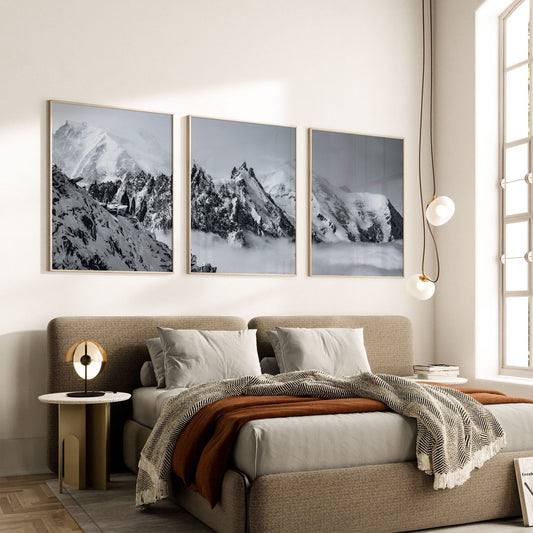
Furniture complicates this in a useful way. A triptych hanging above a sofa doesn't need to match the full wall width, it needs to relate to the sofa width. The standard advice is that the artwork should be around two thirds the width of the furniture below it. A 200cm sofa and a 130cm triptych is a comfortable relationship. A 130cm triptych above a 90cm sofa is not, regardless of what the wall either side is doing.

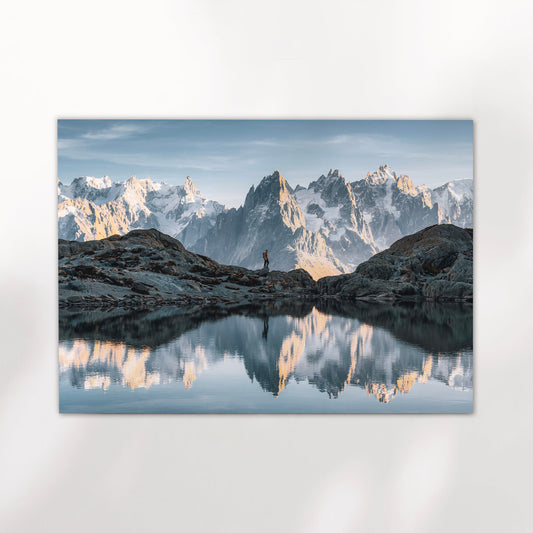
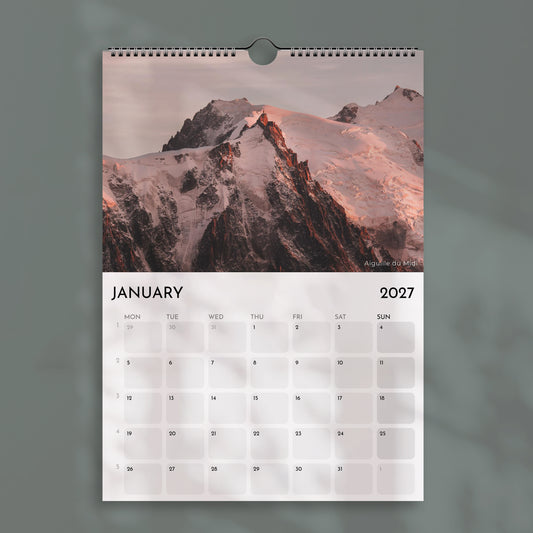
Mont Blanc Massif – Chamonix, France (triptych)
Shot at sunrise above Chamonix, the Mont Blanc Massif spread across three connected panels. Warm alpine light across the peaks, printed on 200gsm fine art matte paper. Available in multiple sizes.
View Product →
How much space between triptych panels
Once the wall margins are sorted, the inter-panel gap is a much smaller decision. For landscape photography where the image runs continuously across all three panels, a gap of 2 to 3 centimetres is enough. It acknowledges that these are three separate pieces without breaking the panorama. Wider than 5cm and the eye starts to read them as individual photographs hanging near each other rather than a single work.
The exact number is less important than consistency. All three gaps must be identical. A 3cm gap on the left and a 3.5cm gap on the right is more noticeable than you'd expect, because the eye goes looking for symmetry and finds it off. Measure both gaps before marking any holes.
One situation where wider gaps work: if the triptych panels have thick frames and the room has a bold, graphic quality to it, a 4-5cm gap can add weight and formality. The Aiguille du Midi black and white triptych in a room with dark walls and strong architectural lines would carry a slightly wider gap well. The same gap on a light, minimal wall with thin frames would look like a measuring error.
For unframed prints, the gap closes further. Many people hang unframed triptych panels with a 1-2cm gap, which makes the whole set read almost as one continuous print. This works particularly well for panoramic landscape shots where the horizon needs to feel unbroken. See the full collection for the range of available sizes.


Height and positioning
Height follows a simple principle: the visual centre of the triptych should sit at roughly eye level. In practice that means the midpoint of the work at around 145 to 150cm from the floor. Most people hang artwork too high. When in doubt, go lower rather than higher. A triptych that sits at eye level when you're standing in the room feels present. One hung at ceiling height feels like it's trying to escape.
Above furniture the calculation changes. Leave 15 to 20cm between the top of the sofa or console and the bottom of the frames. Less than that and the artwork feels like it's sitting on the furniture. More than about 30cm and the connection between the two breaks, and the triptych starts to look like it was hung before the furniture arrived.
One last thing worth saying: the gap between panels is the detail you'll obsess over before hanging and stop seeing within a week. The margins and the height are what you'll live with. Spend your measuring time on those.


Aiguille du Midi – Chamonix, France (triptych)
The Aiguille du Midi rising above cloud in fresh winter snow. Cool blue tones across three panels, printed on 200gsm fine art matte paper. Available unframed in multiple sizes.
View Product →


Triptychs are one of the formats where the hanging decision matters as much as the image choice. Get the margins and height right and the panels look like they were always meant to be there. Get them wrong and even a good photograph looks awkward. It's worth spending an extra ten minutes with a tape measure before you touch a drill.
Mark Fitzsimons, Chamonix Prints
Three panels. One view.
All triptychs printed on 200gsm fine art matte paper. Multiple sizes. Delivered in 5-7 business days.
Browse the Collection →