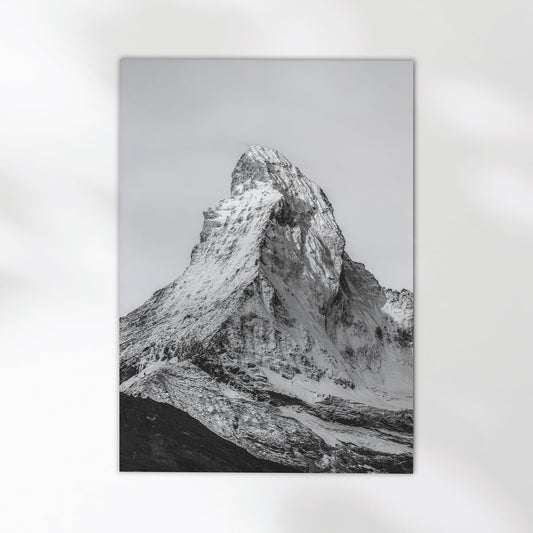
How to Space a Triptych on a Wall: A Practical Guide
Knowing how much space between triptych panels makes the difference between a wall that works and one that doesn't. Here's how to get it right.
Shop Now →The most common mistake people make when hanging a triptych is guessing the gap. Too much space and the three panels start to feel like separate prints. Too little and the image looks compressed, almost claustrophobic. The good news is there's a reliable rule of thumb, and once you understand why it works, it's easy to apply to any wall. This guide covers how much space between triptych panels is right for most situations, plus how to position the whole arrangement so it sits well in the room. If you're considering a triptych for your home, our Aiguille du Midi black and white triptych is a good reference point throughout.
How Much Space Between Triptych Panels
The standard recommendation is to leave between 5 and 10 centimetres (roughly 2 to 4 inches) between each panel. For most triptychs hung in a living room or hallway, 5 to 7 cm is the sweet spot. It's enough of a gap to define each panel as its own piece, but small enough that the eye still reads the three together as a single image.
Where people go wrong is scaling the gap to the wall rather than to the print. A large wall doesn't mean a larger gap. The gap serves the image, not the room. If your panels are A2 size (roughly 42 x 59 cm each), a 5 cm gap is appropriate. If your panels are smaller, say A3, you might bring that down to 4 cm. If they're A1 or larger, 7 to 8 cm works well. The proportional relationship between panel width and gap width should stay roughly consistent regardless of scale.
One practical way to test this before you put anything on the wall: lay the panels on the floor with the gaps you're considering and stand back. What reads well from above will usually read well from across the room. It takes two minutes and saves a lot of re-hanging.
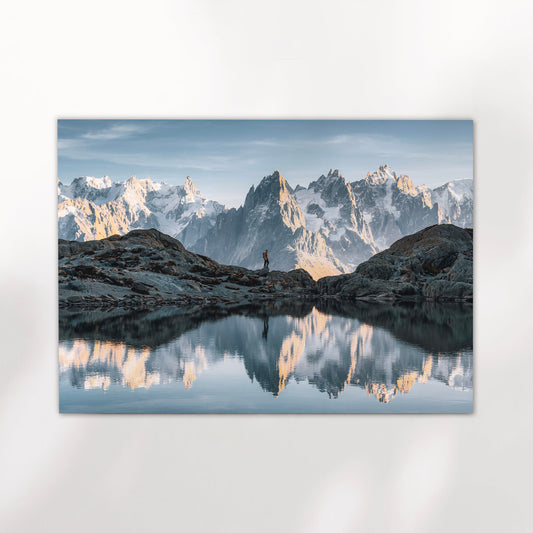
If your triptych is a continuous image split across three panels, as most photographic triptychs are, erring on the tighter side of that 5 to 7 cm range keeps the landscape intact. A golden hour mountain triptych with its warm tones sweeping across the frame is a good example: too much space and the alpenglow on the left panel no longer connects to the ridge on the right.

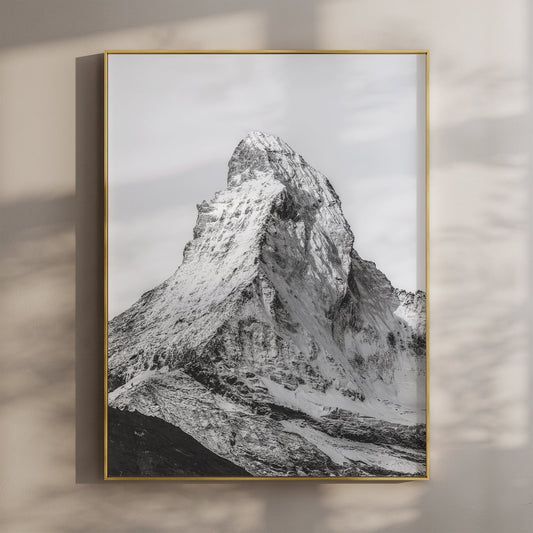
Aiguille du Midi – Chamonix, France (triptych – black & white)
A clean, minimal read of the Mont Blanc massif in black and white. Three panels, one continuous ridge line. Works well in living rooms where you want presence without colour.
View Print →Where to Position a Triptych on the Wall
Spacing between panels is only half of it. Where the whole arrangement sits on the wall matters just as much. The standard rule for hanging any framed art applies here too: the centre of the arrangement should sit at approximately 145 to 150 cm from the floor. That puts the visual midpoint of the triptych at average eye level, which is where the eye naturally rests when you walk into a room.
For a three-panel triptych, the centre of the arrangement means the centre of the middle panel. Measure up from the floor to 148 cm, mark it lightly with a pencil, and hang your middle panel first. Then work outwards, keeping your chosen gap consistent on both sides.
Horizontal centring matters too. A triptych hung off-centre on a wall, or not centred over the furniture beneath it, will feel slightly off even if no one can name why. If the arrangement is going above a sofa or console table, aim for the total width of the triptych to be roughly two thirds the width of the furniture below. A triptych that's wider than the sofa tends to dominate; one that's much narrower looks lost.
For a triptych going on a blank wall with no furniture anchor, centre it both horizontally and vertically within the wall space, or position it deliberately to one side if the room layout calls for it. Either works. What doesn't work is accidental asymmetry.
"Hang the middle panel first, then work outwards. It keeps the spacing honest and gives you something fixed to measure from."


Choosing the Right Panel Size for Your Space
Before you worry about how much space between triptych panels, it's worth checking that the overall size is right for the wall. A common issue is panels that are too small. Three A3 prints above a full-sized sofa, even hung perfectly, will feel underwhelming. As a rough guide, the total width of a triptych, including the gaps, should fill at least half the width of the wall or the furniture beneath it.
For a standard sofa around 220 cm wide, three A2 panels at 42 cm each with 6 cm gaps gives a total width of about 138 cm. That works. Three A1 panels at 59 cm each gives around 190 cm, which is more commanding but still proportional. Going larger than the sofa width starts to feel like the art is pressing in on the room.
If you're unsure, go bigger rather than smaller. Most people regret hanging art too small. A bedroom wall is slightly different — you can afford to be quieter. If you're putting a triptych in a bedroom, the scale can come down a notch. There's more on that in the guide to nature prints for the bedroom, which covers tone and sizing for that specific context.
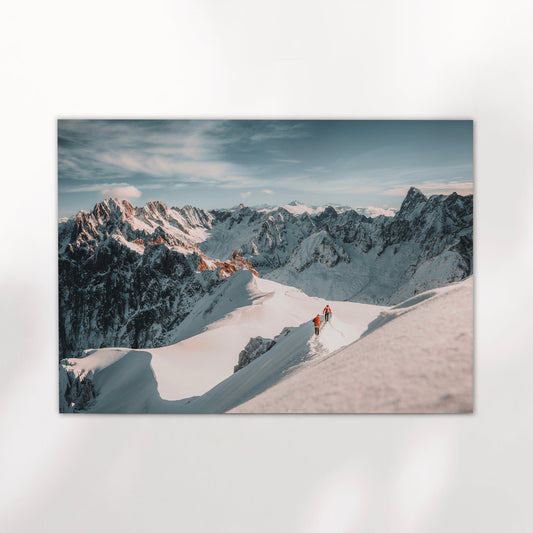
Aiguille Verte, Mer de Glace, Grandes Jorasses – Chamonix, France (triptych)
Three of the most recognisable peaks in the Chamonix valley, caught in the last of the evening light. A broader composition that benefits from the triptych format, with each panel holding its own peak.
View Print →Common Mistakes and How to Avoid Them
Inconsistent gaps are the most frequent problem. If one gap is 5 cm and the other is 7, the triptych will look lopsided even to people who can't say why. Measure both gaps before you fix anything. A laser level or a simple spirit level takes the guesswork out of it.
Hanging too high is the second most common issue. Art tends to get pushed up walls, especially above furniture. Bring it down to where you'd actually look at it from a seated position. That's usually lower than your instinct tells you.
The third mistake is mixing frame styles across the three panels, or using frames that compete with the image. With a photographic triptych, a thin, simple frame, or no frame at all on a mounted print, usually serves the image better than anything heavy or ornate. The blue-toned Aiguille du Midi triptych is a good example of an image that does the work on its own. You don't need to add anything.
If you're working your way towards a wider gallery wall and the triptych is one part of it, treat the triptych as a single unit first. Nail the internal spacing and position, then build the rest of the wall around it. Browse the full print collection if you're looking for individual prints to pair with it.
Tight Gap (4–5 cm)
Works best with smaller panels, A3 and below. Keeps a continuous landscape image cohesive. Good for hallways and compact walls where you don't want the arrangement to spread too wide.
Standard Gap (5–7 cm)
The most reliable range for most rooms and most panel sizes. Gives each panel room to breathe while keeping the triptych readable as a whole. The default starting point.
Wider Gap (8–10 cm)
For very large panels, A1 and above, on wide walls. Anything beyond 10 cm risks breaking the image into three separate prints. Use sparingly and always test with paper templates first.
Find the right triptych for your wall
All our triptychs are printed on museum-quality giclée paper and printed and shipped to your door. Available in multiple sizes to suit your space.
Browse Prints →