Dining Room Wall Art: How to Choose a Print for the Room You Eat In
The dining room gets more eyeballs on its walls than almost anywhere else in the house. It's worth choosing carefully.
Shop Now →Most dining room walls end up with whatever didn't fit somewhere else. A spare print from the study, something picked up because the sideboard looked bare. The problem is that the dining room is the most social space in the house. People sit in it for an hour at a time, at eye level with your walls. It's the one room where the art actually gets looked at, not just noticed on the way past. That changes what you should hang there.
What the Dining Room Demands from a Print
The dining room operates in two very different lighting conditions, often on the same day. Bright overhead or natural light during daytime meals, then lower, warmer artificial light in the evening. That shift matters more for art than most people realise. Prints that depend on subtle colour gradation, or on fine detail in mid-tones, can flatten under a pendant light. What reads beautifully in a well-lit gallery can look muddy above a dinner table.
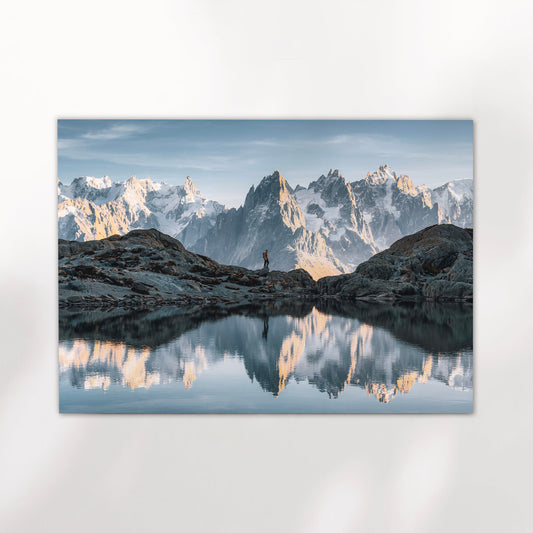
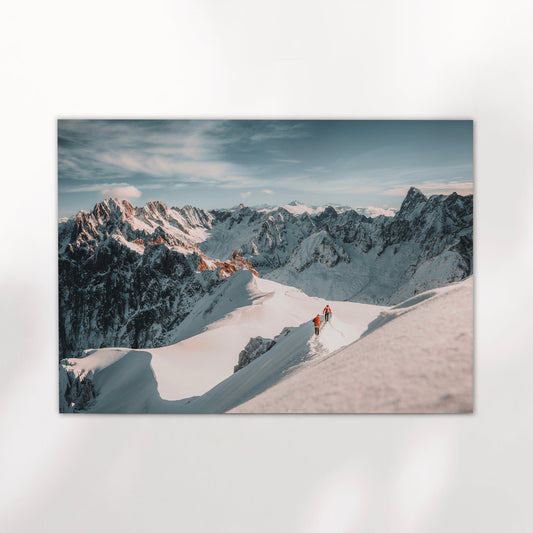
The prints that hold up best have clear subject matter and strong tonal contrast. A mountain ridge against an open sky. A building set into a cliff face with hard shadow underneath it. These images retain their legibility when the light changes. That's not a styling rule. It's just what happens when a pendant drops the ambient light by half.
The other thing to consider is scale. People are seated in the dining room, which means their eye line is lower than in a room where they're standing. Art that would be too dominant in a hallway can feel right in a dining room, because you're looking across at it, not up at it. A 50x70cm print above a sideboard is a reasonable minimum. Below that and it starts to look like it's waiting to be moved somewhere else.
It's also worth noting that the dining room is shared space. Unlike a bedroom, where you're choosing art for yourself, the dining room wall gets looked at by guests. That doesn't mean choosing something bland. It means choosing something that holds a conversation rather than starting one.g that rewards a bit of attention, rather than something that's only legible from across the room or only makes sense to you.

Aescher Guesthouse – Appenzell, Switzerland
The Berggasthaus Aescher sits wedged into the limestone face above Ebenalp. It's one of those places that looks almost too dramatic to be real. This shot captures the building in its full context, cliff above, valley below, with enough tonal depth and contrast to read clearly in a dining room lit by candlelight or midday sun.
View Print →
Size, Placement, and the Sideboard Wall
The most common dining room configuration is a sideboard or credenza on one wall, with blank space above it. The instinct is usually to hang a single print centred over the furniture. That works, but the sizing has to be right. The print should be roughly two-thirds the width of the furniture below it, give or take. Too narrow and the two things look unrelated. Too wide and the print dominates the sideboard rather than sitting with it.
For most standard sideboards, that puts you in the 60x80cm to 70x100cm range. A 50x70cm is fine if the sideboard is on the smaller side. What almost never works is going smaller than that, particularly in a room with a full dining table. The scale of the furniture and the table makes anything too small look like it's borrowed from another room.
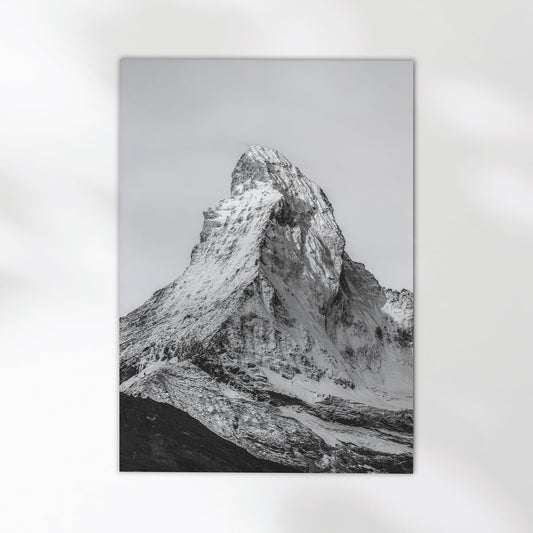
If you're working with a long blank wall that has no furniture beneath it, the rules shift. A single large print can anchor the wall on its own, but it needs to be genuinely large, 70x100cm minimum, and ideally a landscape orientation image that has horizontal presence. Alternatively, a pair of prints side by side can work well, particularly on a wall that's too wide for one print to fill comfortably. The Bionnassay and Grandes Jorasses set of two black and white prints is a good example of how two related images can work together on a longer wall without feeling like a gallery exercise.
Hanging height in the dining room is different from other rooms precisely because guests are usually seated. The centre of the print should be roughly at eye level when seated, which puts it lower than you might instinctively hang it. If in doubt, err lower. Art hung too high in a dining room ends up getting looked at by nobody. For more on how print choices shift between rooms, the guide on living room feature wall ideas is useful context, though the dining room has its own logic.


Why Landscape Photography Works in Dining Rooms
Landscape photography is an underused choice for dining rooms. The assumption is that dining rooms want warmth, and warmth means something figurative or abstract, or at least something that matches the furniture. But cooler landscape tones, the blue-grey of an alpine ridge, the pale greens of a valley, sit easily alongside almost any table setting and don't compete with the rest of the room the way a busy or heavily coloured piece can.
Landscapes also tend to have space in them. Sky, depth, distance. When you're seated across a table and looking at a wall, a print with somewhere for the eye to travel is more restful than one that fills every corner of the frame. That's one reason mountain photography translates well into dining rooms, there's usually a clear focal point, clean edges, and empty sky. The eye has a place to land and a place to rest.
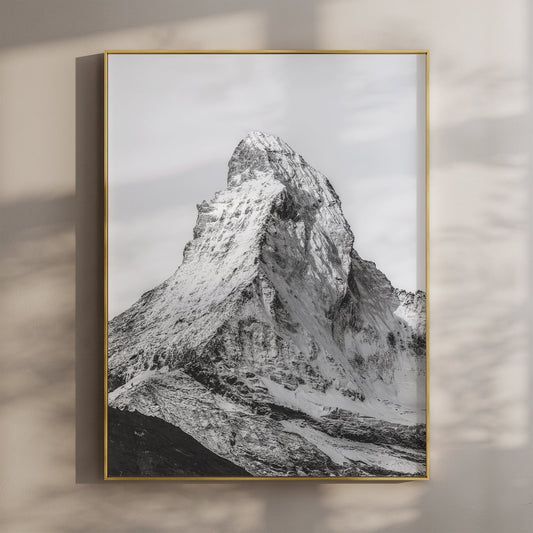
"Black and white mountain photography is probably the most reliable choice for a dining room. It doesn't fight with candles, crockery, curtains, or anything else in the room. It just works."
Black and white is worth considering seriously in the dining room specifically, and not just for aesthetic reasons. The dining table already has colour in it: food, flowers, table settings, wine. A black and white print on the wall removes itself from all of that competition. It holds its presence without pulling focus from what's on the table. The Aiguille de Bionnassay in black and white is a good example of how a monochrome mountain image reads in a room with a lot going on. You can browse the full print collection if you want to see both colour and monochrome options side by side. And if you're also thinking about other rooms in the house, the guide on how a single large print changes a room covers the logic behind committing to one strong image rather than spreading smaller pieces around.


Aiguille de Bionnassay & Grandes Jorasses – Set of 2 (Black & White)
Two black and white mountain prints from the Mont Blanc Massif, designed to hang together. The pairing works especially well on longer dining room walls where a single print would leave too much empty space on either side. Both images are high contrast and clear-subject, so they hold their definition under artificial evening light.
View Print →


The dining room wall gets more sustained attention than any other wall in the house. It deserves a print chosen for it specifically, not one that ended up there by default. Get the size right, think about the light, and pick an image that has enough in it to reward a second look.
Mark, Chamonix Prints
Find the Right Print for Your Dining Room
Mountain, landscape and coastal photography. Museum-quality giclée prints, printed and shipped to your door worldwide.
Browse Prints →